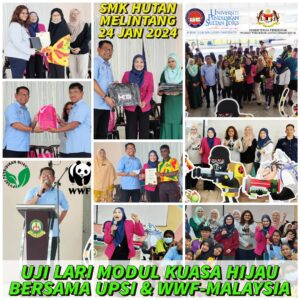
GreenQuest is a dynamic environmental education initiative that merges E-Sports, digital gamification, and sustainability learning in a way that is both academically rigorous and deeply engaging for young learners. Aligned with the EPIC-N Model (Educational Partnerships for Innovation in Communities Network), the program emphasizes sustained university-community-school collaboration to solve real-world environmental challenges through innovative, education-driven approaches. By embedding environmental knowledge into digital platforms and engaging school communities in immersive learning, GreenQuest bridges classroom learning with community impact.
Developed in collaboration with the Pejabat Pendidikan Daerah (PPD) Bagan Datuk, Perak, under the Ministry of Education Malaysia, and supported by UPSI’s EduGreen Centre, the program actively involves 10 selected schools in the Bagan Datuk district, reaching more than 1,000 students and teachers. The approach integrates online and on-site participation, ensuring flexible and accessible engagement regardless of location.
The core objective of GreenQuest is to make environmental education exciting, competitive, and relevant for today’s digital-native students. Using DSKP (Dokumen Standard Kurikulum dan Pentaksiran) as its educational backbone, the program integrates environmental themes into subjects like Science, Geography, and Pendidikan Moral. Students learn about sustainability concepts—such as climate change, biodiversity, pollution, recycling, and energy conservation—through interactive games and challenges that align with national curriculum standards.
A unique feature of the program is the Green E-Sport Challenge, where student teams participate in digital competitions that simulate real-world environmental problem-solving. These E-Sport-style games push students to design green cities, manage virtual ecosystems, or optimize clean energy usage under time and resource constraints—promoting critical thinking, creativity, and teamwork. This gamified learning environment ensures that environmental education is not only informative but also exciting and highly memorable.
Through the EPIC-N framework, GreenQuest emphasizes long-term capacity building. Trained student facilitators and teacher mentors—known as Eco-Educators—play a key role in knowledge transfer, ensuring that each school can sustain and expand environmental education activities even after the initial program period. Teachers receive digital resource kits and ongoing professional development support to facilitate curriculum integration and lead school-based green initiatives.
The hybrid implementation model blends:
Online learning platforms for flexible access to games, tutorials, and quizzes.
On-site events, including mini tournaments, reflection sessions, and innovation showcases, which take place in schools or local community centers.
The program’s impact extends beyond knowledge acquisition to include empowerment, behavioral change, and community awareness. By enabling students and teachers to become agents of change within their schools and neighborhoods, GreenQuest contributes to a culture of sustainability that resonates beyond the classroom.
Aligned with national and global priorities, the project supports key Sustainable Development Goals (SDGs) including SDG 4 (Quality Education), SDG 13 (Climate Action), and SDG 17 (Partnerships for the Goals). It also contributes to the Ministry of Education’s push for digital integration, environmental literacy, and community-based education.
In conclusion, GreenQuest exemplifies how digital innovation, curriculum alignment, and strategic partnerships—guided by the EPIC-N Model—can transform environmental education into a participatory, scalable, and meaningful experience. It empowers students in Bagan Datuk not only to learn about the environment but to become sustainability leaders in their schools and communities.