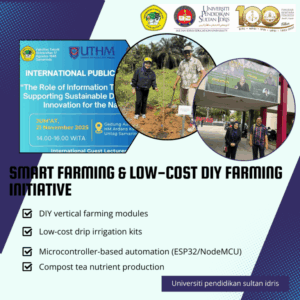
This project, led by Professor Dr Che Zalina Zulkifli, introduces Smart Farming and Low-Cost DIY Farming technologies to support community farmers and student learning in Samarinda, Kalimantan. The initiative addresses the need for affordable, scalable, and sustainable farming methods suitable for both rural and urban communities.
The approach aligns fully with the EPIC-N Model, which connects university expertise with community-driven challenges, ensuring real implementation, measurable outcomes, and long-term impact.
Farmers and local communities in Samarinda face several limitations:
- High cost of modern farming equipment
- Inefficient water usage and traditional irrigation methods
- Lack of exposure to IoT-based agricultural tools
- Limited opportunities for green entrepreneurship
These issues restrict productivity and sustainability, creating a clear need for accessible, low-cost, technology-supported farming solutions.
Project Description
3.1 Smart Farming Technology
EduGreen@UPSI introduced practical and affordable tools:
- IoT soil moisture sensors
- Climate monitoring (temperature, humidity)
- Automated smart watering systems
- Mobile dashboard for real-time monitoring
3.2 Low-Cost DIY Farming Systems
To ensure community scalability, Prof Zalina’s model emphasised affordability and local materials:
- DIY vertical farming modules
- Low-cost drip irrigation kits
- Compost tea nutrient production
- Microcontroller-based automation (ESP32/NodeMCU)
Each system can be built with RM30–RM100, enabling widespread adoption.
3.3 Economic and Business Model Integration
The Faculty of Economy supported:
- Micro-costing of farming operations
- Market analysis for urban farming products
- Business model development for micro-enterprises
- Circular economy concepts (waste → compost → product → income)
Student Engagement & Academic Integration
Following EPIC-N’s experiential learning principle, students:
- Built and tested IoT prototypes
- Conducted on-field deployment in test plots
- Collected and analysed farm data
- Prepared business plans for community farmers
Lecturers incorporated smart farming topics into teaching modules, creating sustainable academic continuity.
Outcomes and Impact
5.1 Community Impact
- Farmers adopt simple, low-cost technologies
- Improved water efficiency through automation
- Increased awareness of sustainable agriculture practices
5.2 Educational Impact
- New curriculum components for Smart Farming and IoT Agriculture
- Cross-faculty collaboration strengthened
- Students gain hands-on, real-world problem-solving experience
5.3 Economic Impact
- Potential 20–40% reduction in operating costs
- Opportunities for student-led agritech entrepreneurship
- Local communities can commercialise DIY farming kits
Future Plans
- Establish EPIC–EduGreen Smart Farming Hub at UNTAG 1945.
- Conduct annual Smart Agriculture Bootcamps for students and communities.
- Produce joint research papers and policy briefs.
- Expand the project to more districts in Kalimantan and ASEAN.
Leadership
This project reflects the leadership of
Professor Dr Che Zalina Zulkifli,
who continues to extend Malaysia’s green technology innovation to the global community through EPIC-N aligned programs.