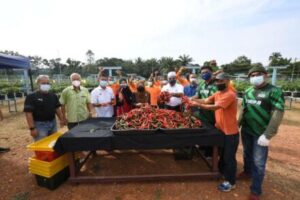
The EduGreen Compost Program at UPSI is a flagship sustainability initiative designed to strengthen environmental education, green lifestyle adoption, and community practice, while embedding sustainability within the academic curriculum.
Led by Prof. Dr. Che Zalina Zulkifli, this programme integrates:
- Academic coursework (Communication course under Faculty of Language & Communication),
- Student leadership development (HEPA Green Portfolio),
- Technical and agricultural guidance from MARDI,
- Hands-on composting infrastructure at EduGreen Centre.
The initiative reflects the EPIC-N philosophy: a real-world sustainability challenge matched with university expertise and an applied learning framework that directly benefits communities.
The EduGreen Compost Program is structured around a three-tier EPIC-N-aligned implementation approach involving academic integration, community engagement, and institutional collaboration.
1. Academic Integration: Communication Course Collaboration
The Faculty of Language & Communication incorporated this project into its “Communication Course”, allowing over 300 students per semester to:
- Practice communication strategies through environmental messaging,
- Produce campaign videos, posters, and awareness materials,
- Conduct presentations and dialogues with local stakeholders,
- Reflect on sustainability practices through structured assignments.
This transforms composting from a technical activity into a communication-driven behavioural change programme, aligned with UPSI’s mission to produce environmentally responsible graduates.
2. Student Leadership (HEPA Green Portfolio)
- Selected student leaders manage compost operations,
- Organise green campaigns at colleges and hostels,
- Monitor food waste collection,
- Conduct workshops for peers and schools,
- Coordinate data reporting (waste diverted, compost produced, participation rates).
This creates a leadership pipeline where students gain environmental management skills while contributing to UPSI’s green campus agenda.
3. Technical Guidance & Local Government Collaboration (MARDI)
- Expertise in composting science,
- Technical validation of the composting system,
- Training modules for university and school participants,
- Advisory support for scaling the programme to district-level agriculture offices.
This strengthens the initiative’s credibility and aligns it with Malaysia’s national agricultural sustainability framework.
4. EduGreen Centre Infrastructure
- Demonstration site for composting technology,
- Training hub for UPSI and external visitors,
- Data collection and monitoring centre,
- Research facility for smart compost innovation (IoT, sensors, etc.).
This infrastructure enables the programme to serve as a national and international model for integrating green technology into education.
Environmental Impact
- Significant reduction of organic waste from UPSI cafeterias and hostels.
- Production of high-quality compost used for campus landscaping and community gardens.
- Measurable decrease in waste collection frequency, contributing to carbon-footprint reduction.
Educational & Academic Impact
- Students experience authentic learning by applying communication theories to real sustainability issues.
- Faculty integrates applied environmental content into assignments and assessments.
- Increased student confidence in public speaking, project management, and advocacy.
Community Engagement
- Workshops delivered to schools and local communities.
- Composting awareness expanded to nearby districts through MARDI collaborations.
- Strengthened public understanding of waste reduction and circular economy practices.
Institutional Impact
- UPSI moves closer to its Green Campus and Green University targets.
- Recognised as a model for other Malaysian universities seeking curriculum-based sustainability integration.
- Strong cross-faculty cooperation—an important indicator of long-term sustainability culture.
Alignment with the EPIC-N Model
The EduGreen Compost Program demonstrates full alignment with EPIC-N’s foundational principles:
1. Community-Identified Needs: Food waste and environmental awareness were key issues identified by:
- HEPA,
- MARDI,
- campus management,
- local communities.
2. University Courses Integrated
The Communication course integrates sustainability into academic learning, making the project part of structured coursework.
3. Long-Term Partnerships
- UPSI (EduGreen Centre, FBK, HEPA),
- MARDI,
- schools and local communities.
4. Student Leadership and Engagement
Students lead compost operations, communication campaigns, workshops, and reporting—demonstrating authentic EPIC-N style engagement.
5. Scalable Model
The programme is now ready for:
- Expansion to all UPSI faculties,
- Replication in Malaysian schools through teacher training,
- International demonstration to Central Asia and Southeast Asia through EduGreen partnerships.
Future Expansion
The next phase includes:
- Integrating IoT and Smart Sensors for automated compost monitoring,
- Producing research publications and a Composting Guidebook,
- Expanding green entrepreneurship models for students,
- Establishing EduGreen Compost Demo Sites in partner schools,
- Preparing the programme as a national EPIC model case study.
The EduGreen Compost Program is a powerful example of how curriculum, community, and technology can merge under the EPIC-N approach.
By combining academic learning, local government support, and real environmental action, UPSI has created a scalable, impactful, and internationally relevant sustainability model. The programme continues to strengthen UPSI’s position as a regional leader in environmental education and green innovation, guided by the visionary leadership of Prof. Dr. Che Zalina Zulkifli and supported by dynamic faculty and community partners.