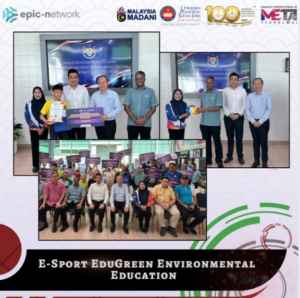
Aligned EPIC Model: Community-Driven Sustainable Development through University–Local Government Partnerships
The E-Sport EduGreen Environmental Education Initiative is an innovative, youth-focused sustainability programme that integrates digital engagement, E-sports culture, environmental literacy, and community behavioural change.
Developed and led by Prof. Dr. Che Zalina Zulkifli, this initiative has rapidly expanded across Malaysian communities, involving:
- 174 green schools in Seberang Perai
- Local government partnerships (MBSP & MBPP)
- WWF–Malaysia collaboration
- Industry support (Flex Technology, Amphenol, CIMB EcoSave, Habitat Foundation)
This model demonstrates an impactful synergy between education, technology, environmental advocacy, and policy relevance—perfectly reflecting the EPIC-N mission of leveraging university expertise to solve community challenges. The programme is built on a multi-layered, community-based EPIC-N structure, with UPSI acting as the academic anchor.
Implementation follows four major pillars:
1. Academic Integration
- Environmental education modules embedded into digital learning, E-sport game design, and STEM-based activities.
- Pre-service and in-service teacher training through EduGreen@UPSI.
- Use of data-driven methodologies to track learning outcomes and behaviour change.
2. Local Government Collaboration
- The Seberang Perai City Council (MBSP) adopted E-Sport EduGreen as part of its city-wide sustainability and anti–single-use plastics campaign.
- Program supports municipal objectives: waste reduction, green campus development, and youth engagement.
3. Industry & Civil Society Support• Industry partners sponsor:
- Digital infrastructure
- School implementation kits
- Educational content production
- WWF–Malaysia contributes expertise in environmental messaging and community outreach.
4. Community & School Engagement
- School tournaments merge E-sport excitement with environmental missions.
- Students complete real-world sustainability tasks (recycling campaigns, green innovation projects) to earn in-game or tournament rewards.
- This framework builds lifelong green habits using a youth-friendly approach.
The project demonstrates measurable achievements aligned with EPIC-N’s outcome-based impact model.
1. Educational Impact
- 30,000+ students reached directly through Eco-Digital activities.
- Significant improvement in environmental awareness, measured through pre/post assessments.
- Increased student leadership in zero-waste and green innovation initiatives.
2. Community Impact
- 174 schools implemented environmental action plans.
- Measurable reduction in single-use plastics in several districts.
- Stronger collaboration between schools, local government, and communities.
3. Institutional Impact
- UPSI recognized as a national leader in digital environmental education.
- Municipal governments adopted the programme as part of their annual sustainability agenda.
- Scalable model for national and regional replication.
4. Policy Influence
- The programme is now used as a reference model for:
- Green school certification
- Youth engagement strategies
- Local government environmental outreach
Alignment with the EPIC-N Model
The E-Sport EduGreen project fully embodies all five EPIC-N pillars:
1. Community-Identified Needs
- waste management,
- single-use plastic reduction,
- lack of youth engagement in environmental programmes.
2. University Support & Academic Integration
- curriculum development,
- research,
- teacher training,
- monitoring and evaluation.
3. Long-Term Partnerships
- MBSP
- WWF–Malaysia
- Industry partners
- Ministry of Education (state-level)
4. Student & Faculty Engagement
- digital innovation
- game design
- community-based environmental projects
- Faculty contribute research, module development, and supervision.
5. Scalable Model with Measurable Impact
This EPIC-N aligned model has already expanded from:• pilot schools → district-wide → state-wide impact
The system can be replicated across ASEAN, Central Asia, and global EPIC-N partners.
Future Expansion
The initiative is now positioned to expand into:
• AI-driven environmental learning modules
• Green E-Sport international tournaments
• Cross-country EPIC-N collaboration (Malaysia–Uzbekistan)
• Youth sustainability leadership academies
With EPIC-N global visibility, this model can become a flagship example of how technology, sustainability, and community partnership can transform environmental education.
The E-Sport EduGreen Environmental Education Initiative stands as an exemplary EPIC-N project—demonstrating how a university-led, community-driven model can generate real, measurable sustainability outcomes while engaging the next generation through innovative digital tools. UPSI and Prof. Dr. Che Zalina Zulkifli continue to commit to expanding this model internationally and contributing to the EPIC-N mission of building sustainable, resilient, community-engaged universities around the world.