Students will work with the Metropolitan Council on climate vulnerability and resiliency story maps of the Metro area and examine flood and heat data layers in the area. Project details coming in October! Read the final student report delivered to the local gov/community partner. Sustainable Communities Partnership Contact Info University Faculty Contact David Kelley Geography […]
Sustainable Development Goal: 13 Climate Action
Ghg Inventory Of Penn State Commuters
Students will develop a method to calculate the greenhouse gas emissions of Penn State student and staff commuters. The project will utilize Penn State specific data such as CATA miles and population changes at University Park. The method will be replicable to Commonwealth Campuses. Read the final student report delivered to the local gov/community partner. […]
Internal and Local Marketing of Sustainable Behavior
Students in the Tippie College of Business created a local marketing campaign to promote sustainable behavior in Iowa City called IC Impact. Their objective was to have IC Impact start a sustainability movement in Iowa City that would lead to a positive impact on the community. Read the final student report delivered to the local […]
Read More… from Internal and Local Marketing of Sustainable Behavior
Sustainability Marketing Plan
Students in the Tippie College of Business Marketing Institute partnered with three Sioux City based community organizations that promote sustainability to better coordinate the organizations’ activities and messaging to the Sioux City public. Read the final student report delivered to the local gov/community partner. Iowa Initiative for Sustainable Communities Contact Info University Faculty Contact Peggy […]
Human Resources Sustainability Training Modules
Students in LER 460 will create training modules for existing or onboarding new employees. Relevant information will include the definition of a sustainable community, past and present sustainability initiatives of the State College Borough, and details to incorporate these initiatives into employees’ work. Read the final student report delivered to the local gov/community partner. Sustainable […]
Read More… from Human Resources Sustainability Training Modules
Stories of Climate Vulnerability in the Twin Cities
Students in ENGL 203, in collaboration with SCP Artist-in-Residence Sarah Nelson, will connect human experiences and climate vulnerability data through story and art. Through library research, ethnographies, artist input, subject interviews, and information from the Metropolitan Council’s Climate Vulnerability Assessment, students will explore climate vulnerability in neighborhoods in the Twin Cities, selected from the localized […]
Read More… from Stories of Climate Vulnerability in the Twin Cities
BGSU Office of Campus Sustainability
Providing orange bicycles to be used during the Court Street Connects Festival, recycling receptacles, and outreach to sustainability focused student organizations. Read the final student report delivered to the local gov/community partner. Vital Communities Initiative Contact Info University Faculty Contact Campus Sustainability Local Government / Community Contact […]
Lusaka’s Expanding EPIC Partnerships Look to Solve Capacity Issues
Like many other African cities, Lusaka is facing rapid urbanization and various challenges related to inequality, climate change, economic opportunity, and service delivery. The city is faced with limited technical capacity to deliver essential services to all 3.3 million people and with a growth rate of about 5% annually, Lusaka’s Local Authority is unable to […]
Read More… from Lusaka’s Expanding EPIC Partnerships Look to Solve Capacity Issues
Driving Change in Lusaka: The EPIC Model’s Role in Transforming the City
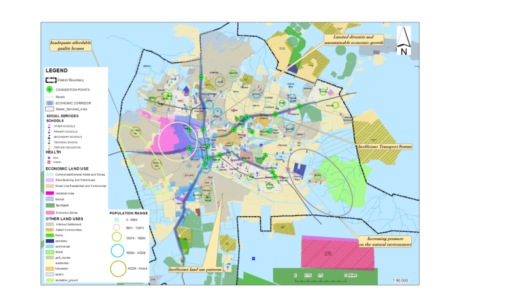
Lusaka’s first international EPIC team began training in 2016-2018, and shortly thereafter, they embarked on a series of experimental projects at the University of Zambia on a range of city-wide issues including climate adaptation, pandemic risk-reduction, and city planning. The overarching objective was to ensure the alignment of new EPIC programs with the existing university […]
Read More… from Driving Change in Lusaka: The EPIC Model’s Role in Transforming the City
The City of Peoria achieves sustainability goals with help from ASU students
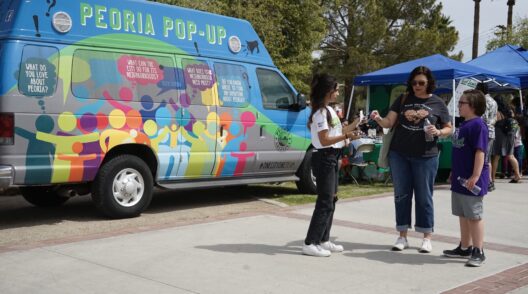
The City of Peoria, Arizona, is a fast growing scenic suburb of Phoenix. Named the best place to live in Arizona by Money Magazine in 2018 and the best place to live, work and play in Arizona by Ranking Arizona in 2021, the city is well-regarded for its thriving economy and exceptional school districts. Founded […]
Read More… from The City of Peoria achieves sustainability goals with help from ASU students