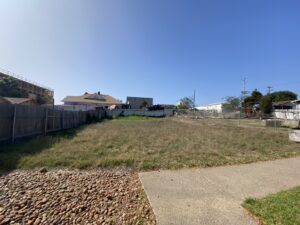
The SDSU Brownfields Assessment Project at San Diego State University (SDSU) aims to support revitalization of the National City downtown area and meet community needs by designing alternative land uses for brownfields in the community, and this report focuses on solutions for one site at 1028 A Avenue in National City, CA. The goals of […]
Read More… from National City Brownfields Revitalization
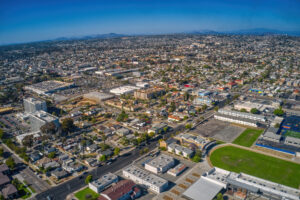
The project reported here represents community partnership work between the city of National City and San Diego State University (SDSU) students. Operating under the university’s Center for Regional Sustainability with grants from the US Environmental Protection Agency (EPA) and the California Department of Toxic Substance Control (DTSC), the SDSU Brownfields Project intends to identify and […]
Read More… from National City Comprehensive Brownfields Reuse Plan
The purpose of this study was to determine the attitudes of the residents of National City toward noise in their community and to compare that to information about the actual noise levels to which the residents are exposed. This is intended to provide information about when and what type of noise may be a problem […]
Read More… from Survey of Noise Exposure in National City Port Area Residents
Energy is a major operating cost for local governments. City of National City has taken many steps to reduce energy usage in its facilities implementing energy efficiency and conservation. The City is now considering the implementation of a microgrid, which is a renewable resource generator that empowers a geographic area to use its own electricity […]
Read More… from Civic Center Microgrid Feasibility Study
National City’s Debris Management Annex is a plan which establishes an organizational structure and process by which National City can coordinate and manage, in the most effective and efficient way, the clearance, removal, and disposal of debris following an emergency or disaster. This annex establishes a Debris Management Organization and outlines Staff, Contractor, and Partner […]
Read More… from Emergency Operations Policy Research and Planning for National City’s Disaster Preparedness and Response
Ninety-seven students enrolled in the upper-division Speech, Language, and Hearing Science (SLHS) 580 course taught by Dr. Henrike Blumenfeld, titled “Communication Processes and Aging,” offered service-based work to support the staff at the Kimball Senior Center and the George H. Waters Nutrition Center. This work also benefitted the students by engaging them in real-world experiences. […]
Read More… from Kimball Senior Center & George H. Waters Nutrition Center
SDSU students conducted a Sustainability Gap (SGAP) Assessment report to identify improvement strategies for the “assessed” establishments in the City of National City. The assessed establishments where the Best Western Plus Marina Gateway Hotel, Goodies Bar & Grill, The Pier 32 Marina, and Ethnic Deli and Café. The overall goal of this Sustainability Assessment assignment […]
Read More… from National City Marina District (3/3)
The climate change mitigation strategies outlined in this report were created through the partnership between National City and the SDSU Sage Project during the fall of 2014. Graduate students in the Public Health 700D course titled “Global Climate Change,” taught by Professor Zohir Chowdhury, elected one of two project options: designing a pedestrian and bicycle […]
Read More… from Mitigation Strategies for a Changing Climate in National City, CA
Five teams of graduate students in the Urban Design and Land Use Planning Studio class at San Diego State University prepared design concepts for various project sites around National City, California. In this project, students and faculty collaborated with city representatives to identify core areas of potential “smart growth” development opportunities within National City. The […]
Read More… from Designing National City
On June 6, 2006, the voters of National City approved Proposition D, a District Sales Tax increase of 1%, raising the sales tax rate in the City from 7.75% to 8.75%. The need for this tax increase was based on a few temporary changes to the City’s revenue. The first was rising General Fund expenditures […]
Read More… from National City Budget Solutions