Marc Schlossberg leads the EPIC-Network Board of Directors to make positive global change

Marc Schlossberg, Ph.D.
Co-Director, Sustainable Cities Institute; Professor, City & Regional Planning
Sustainable City Year Program
University of Oregon
schlossb@uoregon.edu
541-346-2046
Marc’s LinkedIn
Marc’s Twitter
Marc is one of the co-founders of the EPIC-Network and the first EPIC university program. He began the work in 2009. He co-directs the University of Oregon’s Sustainable City Institute which houses the Sustainable City Year Program which is an EPIC-N Member Program. He also serves as faculty, teaching planning students about sustainable transportation options. Read on to learn more about Marc!
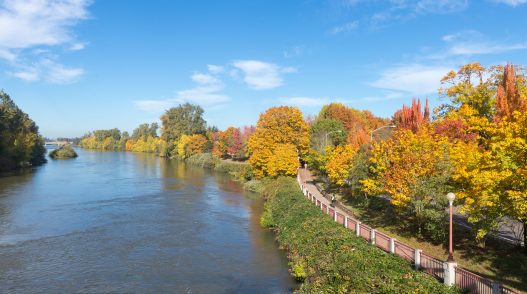
Favorite Place
In Eugene, I can easily go for long walks to the city center, along the Willamette river, or into the mountains and forest along the Ridgeline trail, all from my front door. I can be mostly car-free day to day.
What was your first interaction with a school-community partnership project?
I remember only having one applied project in each of my undergraduate and masters degrees and those were the highlights of the degrees. In graduate school I had a class where I was able to recommend the development of a new light rail line, identify its location and dimensions, and share it with the local transit agency. It was cool. In undergrad, my most applied class (in business) was developing a marketing campaign for a rental car agency and I really enjoyed the creative aspect of that. But really, my first real university-community experience came from being a Professor and linking my own courses on bicycle transportation and participatory GIS with community clients in 2005 or so.
What are some of the top priorities you are working on this year?
Expanding the model internationally and securing more permanent funding for our program at the University of Oregon.
How did you first learn about EPIC-N?
In short, I helped create it. After co-creating the Oregon program, other schools began to adopt what was to become the EPIC Model. Sitting with a few people in San Diego, we came up with the name EPIC so that people didn’t keep referring to their programs as something based on “the Oregon Model.”
In what ways are you looking to engage, or work with others, either from within the EPIC-Network, or in general?
I want to inspire everyone to keep doing great work and identifying those who want to help train and mentor new programs.
Why do you think the EPIC-Network is important?
It’s important to pull people together who are committed to changing higher education around the world so that we can help communities more rapidly and more effectively meet critical environmental challenges.
What is your favorite part of the EPIC-Network
The people who are part of it are amazing human beings.
What do you want a community, or university, to know about the EPIC-Network?
We are a group of people ready and willing to share our experiences to help others develop their own effective programs.
What led you to participate within the EPIC-Network in your current capacity?
My whole reason for getting a PhD and going into academia was to find a way to better leverage university resources for community change and EPIC is exactly that.
Bio
Marc Schlossberg is a Professor of City and Regional Planning and co-director of the Sustainable Cities Institute (SCI) at the University of Oregon where he has been since 2001. His teaching, research, and community engagement focuses on active transportation, livable community design, and the implementation of knowledge to policy and practice. A fun fact is that Marc has four times taught a study abroad course on designing cities for people on bikes, bringing students to Denmark and the Netherlands to learn first-hand from the best cycling cities in the world. Marc is a two-time Distinguished Fulbright Scholar serving in the United Kingdom from 2009-10 and Israel from 2015-16. Prior to academia, Marc worked in the nonprofit sector and was a U.S Peace Corps volunteer in Fiji.